

I agree however his is only a 20 Watt panel flat on top of his Van so he isn't going to get anything like a 4 amp average...Originally Posted by BillsGU




I agree however his is only a 20 Watt panel flat on top of his Van so he isn't going to get anything like a 4 amp average...
Dolphins are so smart that within a few weeks of captivity, they can train people to stand on the very edge of the pool and throw them fish.
I will be chasing the sun for part of the day with the panel. I think I might have to get a bigger panel by the sounds of things. Thanks everyone for your advice.
Cheers Mick
Everyone makes mistakes, the trick is to make them when no-one is looking.
Maybe, maybe not... whilst the 20 will probably not bring the Battery up to 100% State of Charge (SOC) in a day it will go close so will significantly extend the time for the Battery use.
IF you do and IF you are still only powering lighting and water you won't need much bigger IE a 40 would be heaps and should replace the overnight useage and keep your battery at or near 100% SOC.
IF, however, you want to future proof it a bit then maybe go for a 60... depends on your budget
I assume you have a 3 Way fridge in the Van and if that is the case the majority pull heaps of current so running that on Solar is problematic and you are better to keep it on gas.
Dolphins are so smart that within a few weeks of captivity, they can train people to stand on the very edge of the pool and throw them fish.
molongmick (14th February 2011)
Fair bit of chatter on batteries so i thought i could offer 2 cents.....
http://www.amaronbatteries.com.au/
I guess after the 'Union Carbide' disaster in the 80's. R&D was maxed on these. had them for about 8 months now and cant think of any real probs with them. Just replaced my starter motor, so i guess the old starter applied extra work for them. Run a 60 litre engel all day for months at a time, lighting for fishing on beach almost everyday. I would recommend to consider them. But i havent had them long enough to 'Know' just how good they are.
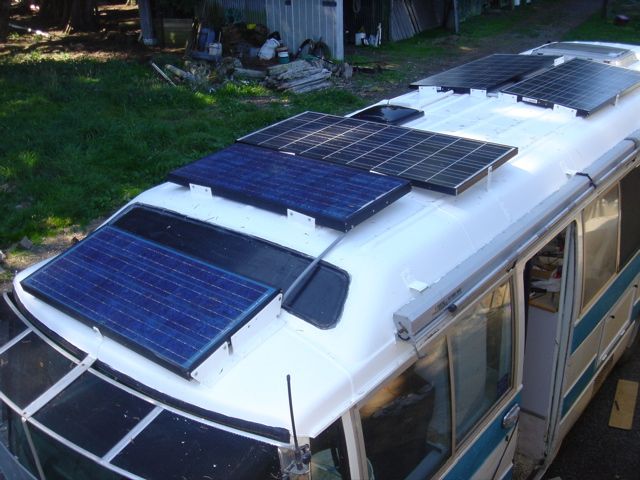
80 watt solar panel on roof rack.

A 20w panel will be fine for 'trickle charging' the 100Ah battery, ie. keeping it topped up when vehicle is not being used. However it is way too small for practical re-charging, it would take too long.
I note that the OP says "The battery is set up to charge while driving, so the battery should be fully charged upon arriving at camp site." This is not quite how some might expect. Consider that to get a reasonable life out of your expensive battery it is good practice not to discharge it beyond 50% capacity. So in a fully charged 100Ah battery you would have 50Ah useable capacity. Further consider that an alternator will quickly bring a battery up to around 70% capacity, but to charge the battery beyond that would require you to be driving for many many hours. Around 70% is a practical expectation of charge from the alternator.(And quite sufficient for starting a vehicle). If you only discharge to 50%, you can see that in effect you are only able to access 20% of your batteries capacity - ie 20Ah in a 100Ah battery! There are a variety of solutions to this problem, which all focus upon more efficient charging of the battery. Essentially, in the absence of sufficient solar input via a reasonable quality regulator you need a multi stage smart charger. The two common ways of doing this are A) a battery to battery smart charger (Eg. Sterling) or a cheaper alternative & widely used in motorhomes B) run an inverter off the cranking battery to power a smart charger to charge your auxillary battery. This will effectively more than double the useable capacity of your battery.
Please note that I am not a battery or solar expert, but have managed to set up a system in our bus that allowed us to be self sufficient off grid for an 18 month around Oz trip.
The following link may explain better what I have tried to say. fridge-and-solar
regards
Cuppa
 Posting Permissions

 Reply With Quote
